⚡ Key Facts – Taj Mahal
ℹ️ Closed every Friday for prayers. Indian nationals pay ₹50. (Fees verified 2024 – verify at official site before visiting.)
History of Taj Mahal
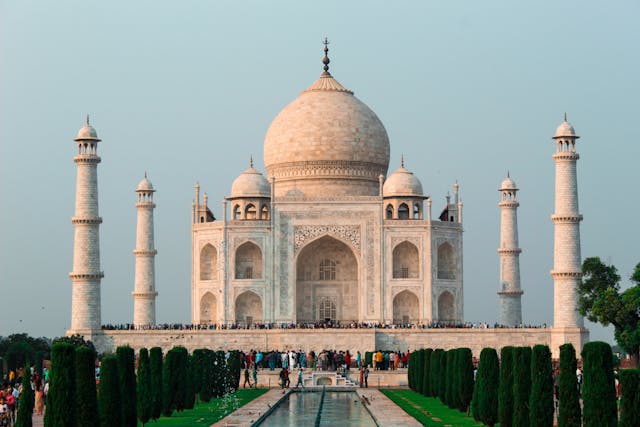
The Taj Mahal was commissioned in 1631 by Mughal emperor Shah Jahan to memorialise his beloved wife Mumtaz Mahal, who died during the birth of their 14th child. Construction began in 1632 and employed over 20,000 artisans drawn from across India, Persia, the Ottoman Empire, and Europe. The chief architect is believed to have been Ustad Ahmad Lahauri of Lahore. The project cost approximately 32 million rupees at the time. After completion, Shah Jahan was deposed and imprisoned by his son Aurangzeb in Agra Fort, where he spent his final years gazing at the Taj Mahal across the Yamuna River. He was buried alongside Mumtaz Mahal when he died in 1666. The monument was inscribed as a UNESCO World Heritage Site in 1983 and draws over 7 million visitors annually.
Architecture & Design
The Taj Mahal is considered the pinnacle of Mughal architecture, blending Persian, Islamic and Indian traditions. The central white marble dome (amrud or guava shape) stands 73 m high, flanked by four 40-m minarets tilted slightly outward – an engineering precaution so they would fall away from the tomb if they ever collapsed. The walls feature elaborate pietra dura (stone inlay) using 28 types of precious and semi-precious stones including lapis lazuli, jade, crystal and turquoise. The Quranic calligraphy inscriptions use gradually larger letters as they ascend, so they appear uniform from ground level. The charbagh garden is divided into four sections by water channels, symbolising the four rivers of paradise in Islamic tradition. The entire complex is perfectly symmetrical east–west; the mosque on the western side has a matching jawab (answer) building on the east purely for symmetry.
Travel Tips & Visitor Information
Fun Facts & Did You Know?
- The Taj Mahal appears to change colour throughout the day – pinkish at dawn, brilliant white at noon, golden at sunset and silvery blue under the full moon
- The four minarets lean slightly outward so they would fall away from the mausoleum, not onto it, in the event of an earthquake or collapse
- The foundations rest on a timber raft – the moisture from the Yamuna River seeps up through the wood and keeps it from decaying
- Over 1,000 elephants were used to transport building materials to the site during construction
- The precious stone inlay includes lapis lazuli from Afghanistan, turquoise from Tibet, jade from China and carnelian from Arabia
- The reflecting pool is not filled with running water; it is kept still so the perfect mirror reflection of the dome is preserved
How to Get There
Nearby Cities: Agra (on-site), New Delhi (200 km), Mathura (58 km), Jaipur (240 km)
Official Website: https://www.tajmahal.gov.in ↗