⚡ Key Facts – Christ the Redeemer
ℹ️ Ticket includes cogwheel train or van transport to the summit. Book online. (Fees verified 2024 – verify at official site before visiting.)
History of Christ the Redeemer
The concept for a large statue of Christ overlooking Rio de Janeiro was first proposed in the 1850s by Catholic priest Pedro Maria Boss, but the idea gained real momentum in 1921 when Catholic circles launched a national fundraising campaign. A design competition resulted in engineer Heitor da Silva Costa's winning concept, which was refined with French sculptor Paul Landowski, who created the statue's hands and face in his Paris studio. Romanian sculptor Gheorghe Leonida worked on the face details. Construction began in 1926. The soapstone tiles covering the exterior were manufactured in Sweden and hand-applied piece by piece by local artisans, many of whom signed the tiles as a form of devotion. The statue was inaugurated on 12 October 1931. It stands within Tijuca National Park, the world's largest urban forest, which was designated a UNESCO World Heritage Site in 1992. Major restorations were carried out in 1980 and 2010.
Architecture & Design
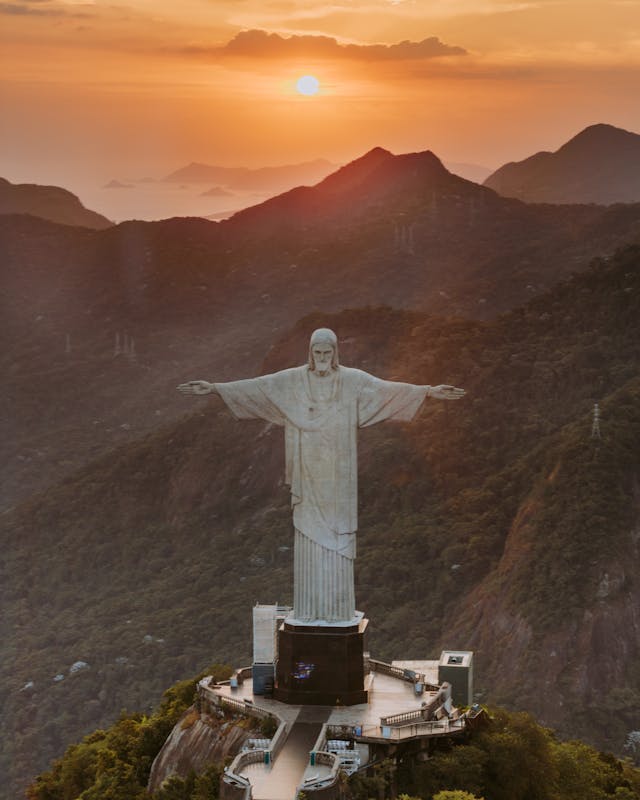
Christ the Redeemer is an Art Deco masterpiece characterised by its clean geometric lines rather than ornate classical religious detail. The statue stands 30 m tall (98 ft) on an 8-m pedestal, for a combined height of 38 m (125 ft). The outstretched arms span 28 m (92 ft). It weighs approximately 635 metric tonnes. The outer surface consists of around 6 million triangular soapstone tiles arranged in a mosaic pattern and fixed with a specially formulated adhesive; soapstone was chosen for its durability, resistance to thermal expansion, and off-white colour. The internal structure is reinforced concrete poured over a steel armature. The statue is equipped with a lightning rod system – necessary because it is struck multiple times a year. A chapel dedicated to Nossa Senhora Aparecida exists inside the base, with capacity for 150 people, used for weddings and baptisms.
Travel Tips & Visitor Information
Fun Facts & Did You Know?
- The statue has been struck by lightning many times; in 2014 lightning broke off a finger on the right hand, and in 2023 a storm damaged the left thumb
- The 6 million soapstone tiles were manufactured in Limhamn, Sweden, shipped to Brazil, and hand-applied by Rio artisans many of whom signed tiles as personal dedications
- On exceptionally clear days visibility from the summit extends 55 km, reaching Niterói, the Atlantic Ocean and the mountains of the Serra dos Órgãos
- Pope John Paul II blessed the statue on his 1980 visit; Pope Francis celebrated Mass here in 2013
- The statue's pedestal contains a small chapel (Nossa Senhora Aparecida) where couples can be married with a backdrop of the entire city
- Christ the Redeemer was the last of the New 7 Wonders announced on the list (alphabetically) but the most recently built of all seven
How to Get There
Nearby Cities: Rio de Janeiro (on Corcovado Mountain within city limits)
Official Website: https://www.tremdocorcovado.rio ↗