New 7 Wonders of the World
🌍 New 7 Wonders of the World Directory: A single fact-checked reference for the seven monuments over 100 million voters worldwide picked in 2007 — the Taj Mahal (India, 1643), Great Wall of China (700 BC), Chichén Itzá (Mexico, 6th–10th century), Petra (Jordan, 312 BC), Machu Picchu (Peru, 1450 AD), Christ the Redeemer (Brazil, 1931) and the Colosseum (Rome, 80 AD). Together these seven sites draw roughly 32M+ visitors a year, span 4 continents and cover seven distinct building traditions — solid groundwork whether you're mapping a bucket-list trip or a tour operator sizing up global heritage-travel demand. Browse by country: China | India | Mexico | Jordan | Peru | Brazil | Italy.
▶ Jump to a Wonder
| Wonder | Location | Continent | Built / Era | Best Time |
|---|---|---|---|---|
| Great Wall of China | China | Asia | c. 700 BC (Ming era) | April–May, September–October |
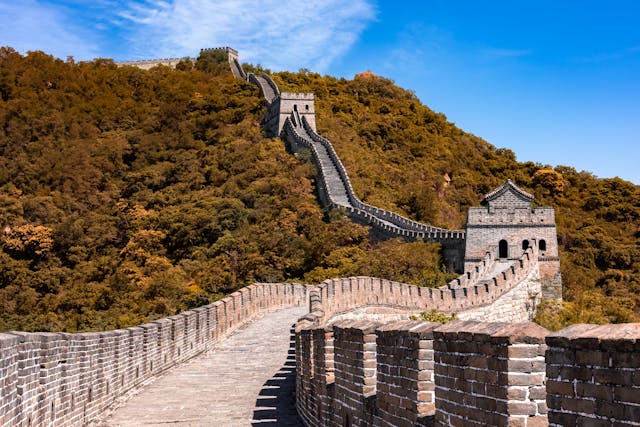 Great Wall of ChinaA massive series of fortifications stretching over 21,000 km across northern China. Built by successive dynasties, the most famous sections date from the Ming Dynasty (1368–1644). Its winding path across mountains demonstrates incredible ancient engineering. Learn More → | ||||
| Taj Mahal | Agra, India | Asia | Completed 1643 | October–March |
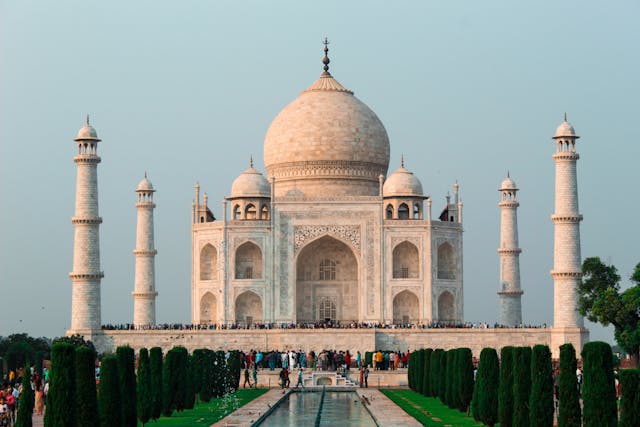 Taj MahalA stunning white-marble mausoleum built by Mughal emperor Shah Jahan in memory of his beloved wife Mumtaz Mahal. Combining Persian, Islamic and Indian styles, it took over 20,000 workers 22 years to complete. A global symbol of eternal love. Learn More → | ||||
| Chichén Itzá | Yucatán, Mexico | North America | c. 6th–10th century AD | December–February |
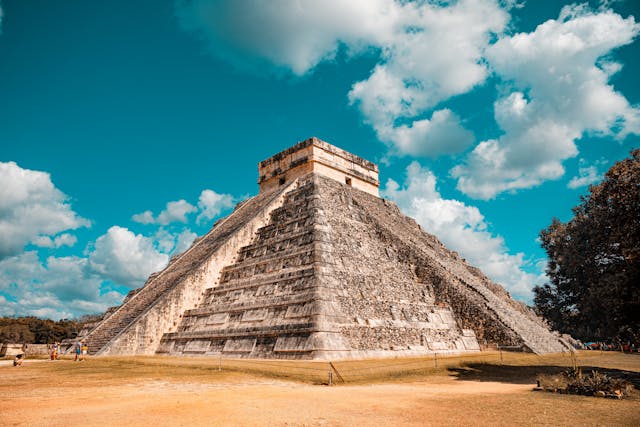 Chichén ItzáAn ancient Maya city featuring the famous El Castillo pyramid, where during equinoxes sunlight creates a shadow resembling a serpent descending the stairs. This pre-Columbian site also includes a massive ball court and astronomical observatory. Learn More → | ||||
|
| ||||
| Petra | Jordan | Asia | c. 312 BC | March–May, September–November |
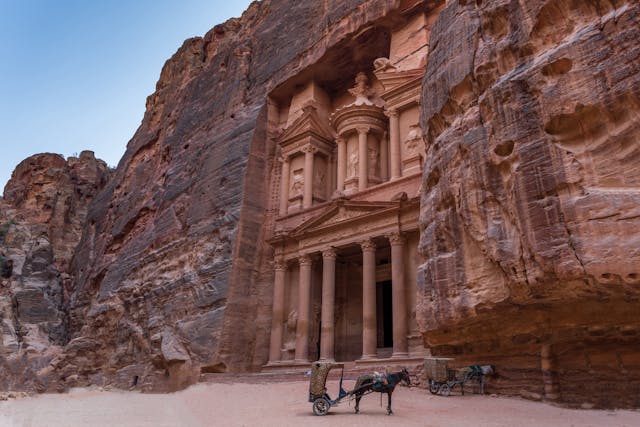 PetraKnown as the "Rose City" for its pink-red sandstone cliffs, Petra was the capital of the Nabataean Kingdom. This archaeological marvel features elaborate facades carved directly into rock faces, including the iconic Treasury building. Learn More → | ||||
| Machu Picchu | Cusco Region, Peru | South America | c. 1450 AD | May–October (dry season) |
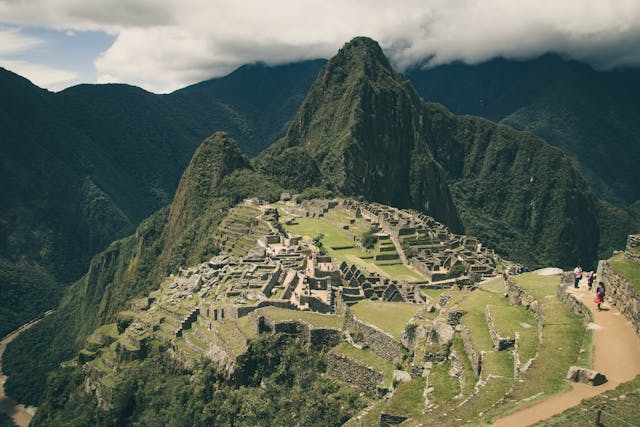 Machu PicchuA breathtaking 15th-century Inca citadel perched at 2,430 m in the Andes Mountains. Built with precisely cut stones fitted together without mortar. Rediscovered in 1911, it is now the most visited tourist destination in Peru. Learn More → | ||||
| Christ the Redeemer | Rio de Janeiro, Brazil | South America | Completed 1931 | May–September (dry season, clearer skies) |
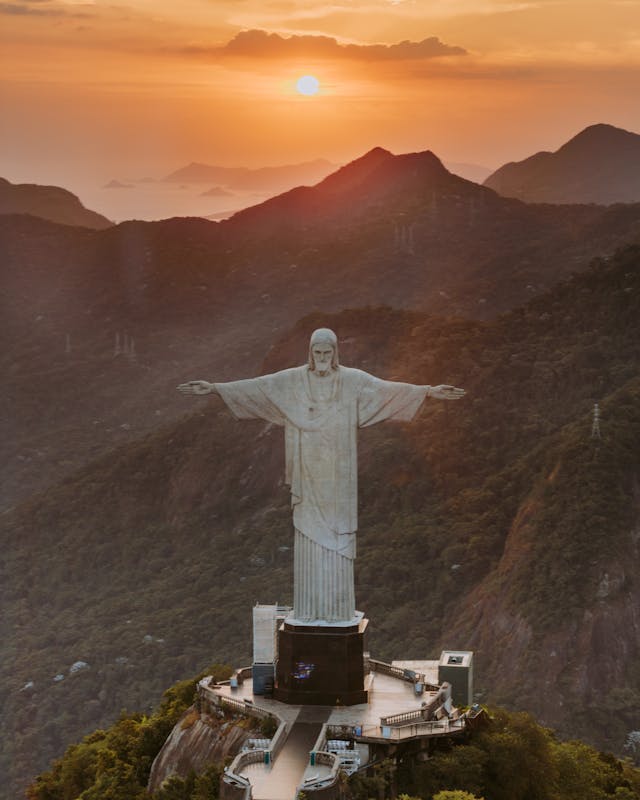 Christ the RedeemerA colossal Art Deco statue of Jesus Christ standing atop 710-metre Corcovado Mountain overlooking Rio de Janeiro. Standing 38 metres tall with arms spanning 28 metres, it is constructed of reinforced concrete and soapstone tiles. Learn More → | ||||
| Colosseum | Rome, Italy | Europe | Completed c. 80 AD | April–May, September–October |
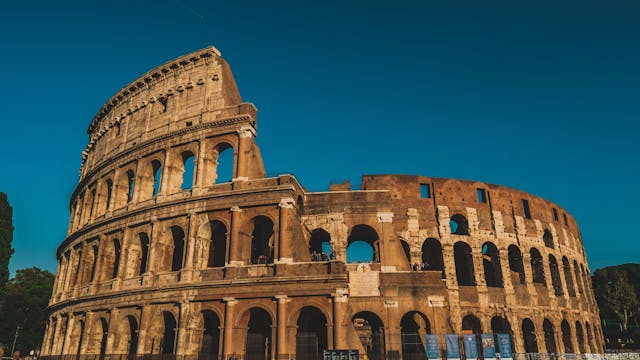 ColosseumA massive stone amphitheatre in the heart of Rome, originally capable of seating 50,000–80,000 spectators. Built by emperors Vespasian and Titus, it hosted gladiatorial contests and public spectacles for nearly 400 years. Learn More → | ||||
Great Wall of China
A massive series of fortifications stretching over 21,000 km across northern China. Built by successive dynasties, the most famous sections date from the Ming Dynasty (1368–1644). Its winding path across mountains demonstrates incredible ancient engineering.
Learn More →Taj Mahal
A stunning white-marble mausoleum built by Mughal emperor Shah Jahan in memory of his beloved wife Mumtaz Mahal. Combining Persian, Islamic and Indian styles, it took over 20,000 workers 22 years to complete. A global symbol of eternal love.
Learn More →Chichén Itzá
An ancient Maya city featuring the famous El Castillo pyramid, where during equinoxes sunlight creates a shadow resembling a serpent descending the stairs. This pre-Columbian site also includes a massive ball court and astronomical observatory.
Learn More →Petra
Known as the "Rose City" for its pink-red sandstone cliffs, Petra was the capital of the Nabataean Kingdom. This archaeological marvel features elaborate facades carved directly into rock faces, including the iconic Treasury building.
Learn More →Machu Picchu
A breathtaking 15th-century Inca citadel perched at 2,430 m in the Andes Mountains. Built with precisely cut stones fitted together without mortar. Rediscovered in 1911, it is now the most visited tourist destination in Peru.
Learn More →Christ the Redeemer
A colossal Art Deco statue of Jesus Christ standing atop 710-metre Corcovado Mountain overlooking Rio de Janeiro. Standing 38 metres tall with arms spanning 28 metres, it is constructed of reinforced concrete and soapstone tiles.
Learn More →Colosseum
A massive stone amphitheatre in the heart of Rome, originally capable of seating 50,000–80,000 spectators. Built by emperors Vespasian and Titus, it hosted gladiatorial contests and public spectacles for nearly 400 years.
Learn More →Quick Comparison: 7 Wonders at a Glance
| Wonder | Age (approx.) | Annual Visitors | UNESCO Year | Key Stat |
|---|---|---|---|---|
| Great Wall | ~2,700+ yrs old | 10M+ | 1987 | 21,196 km long |
| Taj Mahal | ~380 yrs old | 7.5M | 1983 | 73 m tall |
| Chichén Itzá | ~1,400 yrs old | 2.5M | 1988 | 365 steps |
| Petra | ~2,300+ yrs old | ~1M | 1985 | 85% unexcavated |
| Machu Picchu | ~575 yrs old | 1.5M | 1983 | 2,430 m elevation |
| Christ Redeemer | ~93 yrs old | 2M | 1992 | 38 m tall |
| Colosseum | ~1,945 yrs old | 7.6M | 1980 | 80,000 capacity |
Understanding the New 7 Wonders of the World
The New 7 Wonders line-up brings together seven landmark feats of engineering and craftsmanship spanning more than 2,700 years. Unlike the ancient Seven Wonders catalogued by Greek writers, this modern set was chosen through an open, worldwide vote run by the New7Wonders Foundation between 2000 and 2007. More than 100 million people cast a ballot, making it one of the largest public polls ever held on any topic.
Announced on July 7, 2007 (07/07/07) in Lisbon, Portugal, the seven winners were narrowed down from an original shortlist of 200 monuments. The final line-up spreads across four continents: Asia (Great Wall of China, Taj Mahal, Petra), Europe (Colosseum), North America (Chichén Itzá) and South America (Machu Picchu, Christ the Redeemer). Every site carries its own story of empire, faith, craftsmanship or artistic ambition.
These sites pull in millions of visitors a year and generate real tourism revenue for their host countries — a pattern that hospitality brands and market-research teams tracking global travel demand watch closely, right alongside more basic figures like a nation's population or currency. Beyond the balance sheet, each wonder still works as a national emblem — proof of staying power across centuries. Most also hold UNESCO World Heritage status, which brings binding conservation funding and legal protection rather than just a ceremonial title.
Historical Significance and Cultural Impact
Each wonder carries a distinct civilisation's story — spanning 2,300 years of human history across four continents.
Over 2,000 years of dynasty-era construction; 21,196 km total length built by millions of workers to defend against northern invasions. Located in China.
Major Maya city (~600–1200 AD) demonstrating advanced astronomy; El Castillo's 365 steps align precisely with the solar calendar. Located in Mexico.
Inca royal estate built c. 1450 AD at 2,430 m altitude; abandoned ~100 years after Spanish conquest and rediscovered in 1911. Located in Peru.
Art Deco masterpiece completed in 1931; 38 m tall statue on 710 m Corcovado peak, visible up to 20 km across Rio de Janeiro. Located in Brazil.
Architectural Styles and Engineering Marvels
Every wonder solved a unique engineering problem that still astonishes modern architects and scientists.
Rammed earth, brick and stone adapted to local terrain; watchtowers every 500 m relay signal fires across 21,000+ km in minutes.
Pietra dura inlay using 28 types of precious stones; 4 identical minarets lean outward so an earthquake won't topple them onto the tomb.
80 entrances let 50,000 spectators enter and exit in under 15 minutes; underground hypogeum had lifts to raise animals directly into the arena.
El Castillo's 365 steps = days of the year; during equinoxes a serpent shadow appears — engineered by the Maya 1,000+ years ago.
Rock-cut facades carved into 40 m sandstone cliffs; 200 km of pipes and cisterns collected rainwater to sustain a city of 20,000 in the desert.
Ashlar masonry: stones fitted without mortar so tightly a blade can't pass between them — allows slight movement during earthquakes without collapse.
Built on reinforced concrete over 710 m peak; soapstone tiles replace cracked stones individually; a lightning rod runs through the statue's arm.
Tourism and Travel Planning
Visiting all seven wonders has become a popular bucket-list goal for travellers worldwide. The Great Wall is accessible from Beijing, China, with popular sections at Badaling and Mutianyu. The Taj Mahal in Agra, India, benefits from online pre-booking; it is closed every Friday. The Colosseum in Rome, Italy, requires advance tickets to skip 3–4 hour queues – the full-experience ticket includes the underground hypogeum and arena floor.
Chichén Itzá can be visited as a day trip from Cancun or Mérida, Mexico; early morning arrival (8 am) is essential to beat the heat and tour buses. Petra, Jordan, requires at least a full day; the Petra by Night experience (Mon, Wed, Thu) is especially atmospheric. Machu Picchu, Peru, has strict government-imposed daily visitor limits (~5,600 per day) and requires advance online booking, often months ahead during peak season.
Christ the Redeemer in Brazil involves a cogwheel train or van ride up Corcovado Mountain; book online to avoid queuing 2–3 hours. Travellers should consider seasons, crowd levels and local festivals when planning. Explore each country's profile — China, India, Italy, Mexico, Jordan, Peru, Brazil — for visa, currency and population data.
How Far Apart Are the 7 Wonders?
Planning a multi-country wonder-hopping trip? Petra and Colosseum are the closest pair on the list, about 2,418 km apart, while Great Wall and Christ Redeemer sit almost on opposite sides of the planet — roughly 17,270 km apart. The grid below gives the straight-line ("as the crow flies") distance between every pair, useful for sketching a realistic round-the-world itinerary before pricing out flights.
| Distance (km) | Great Wall | Taj Mahal | Chichén Itzá | Petra | Machu Picchu | Christ Redeemer | Colosseum |
|---|---|---|---|---|---|---|---|
| Great Wall | — | 3,768 | 12,766 | 7,142 | 16,878 | 17,270 | 8,068 |
| Taj Mahal | 3,768 | — | 14,502 | 4,143 | 16,586 | 14,132 | 6,073 |
| Chichén Itzá | 12,766 | 14,502 | — | 11,771 | 4,151 | 6,908 | 9,355 |
| Petra | 7,142 | 4,143 | 11,771 | — | 12,454 | 10,266 | 2,418 |
| Machu Picchu | 16,878 | 16,586 | 4,151 | 12,454 | — | 3,279 | 10,578 |
| Christ Redeemer | 17,270 | 14,132 | 6,908 | 10,266 | 3,279 | — | 9,203 |
| Colosseum | 8,068 | 6,073 | 9,355 | 2,418 | 10,578 | 9,203 | — |
Distances are straight-line great-circle measurements, not driving or flight-route distances. Curious how far these sites are from your own city instead? Check any country page's travel-distance widget.
Best Time to Visit Each Wonder
Timing your visit avoids crowds, extreme weather and closures. Green = ideal months, blue = acceptable, red = avoid.
| Wonder | Jan | Feb | Mar | Apr | May | Jun | Jul | Aug | Sep | Oct | Nov | Dec | Notes |
|---|---|---|---|---|---|---|---|---|---|---|---|---|---|
| 🏯 Great Wall | Avoid | Avoid | OK | Best | Best | OK | Avoid | Avoid | Best | Best | OK | Avoid | Autumn (Sep–Oct) for clear skies & foliage; Spring (Apr–May) for cool days. Avoid July–Aug (38 °C+) and peak Golden Week.Best: Sep–Oct & Apr–May. Avoid Jul–Aug heat & Golden Week. |
| 🕌 Taj Mahal | Best | Best | OK | OK | Avoid | Avoid | Avoid | Avoid | Best | Best | Best | Best | Oct–Feb is ideal: clear skies, 20–25 °C. Avoid May–Aug (45 °C+ and monsoon humidity). Closed every Friday.Best: Oct–Feb. Avoid May–Aug heat. Closed Fridays. |
| 🏛️ Chichén Itzá | OK | OK | Best | Best | Best | OK | OK | Avoid | OK | Best | Best | OK | Dec–Apr (dry season, 28–32 °C). Arrive before 10 am to beat tour buses. Sep 21 equinox snake-shadow is spectacular but extremely crowded.Best: Dec–Apr, dry season. Arrive early. Sep 21 equinox is crowded. |
| 🌹 Petra | OK | OK | Best | Best | Best | Avoid | Avoid | Avoid | Best | Best | Best | OK | Mar–May and Sep–Nov: 20–25 °C, dry. Avoid Jun–Aug (40 °C+). Petra by Night runs Mon/Wed/Thu — book ahead.Best: Mar–May & Sep–Nov. Avoid Jun–Aug heat. Night tours Mon/Wed/Thu. |
| 🏔️ Machu Picchu | Avoid | Avoid | OK | OK | Best | Best | Best | Best | Best | OK | Avoid | Avoid | May–Oct (dry season): clear mountain views, cool nights. Jun–Aug most popular — book months ahead. Nov–Apr brings daily rain but far fewer crowds.Best: May–Oct, dry season. Jun–Aug busiest — book early. |
| ✝️ Christ Redeemer | OK | OK | OK | OK | OK | Best | Best | Best | Best | OK | OK | OK | Jun–Sep (dry season): clearest panoramic views of Rio. Cloudy days obscure views entirely — check forecast before going.Best: Jun–Sep, clearest views. Check forecast — clouds block the view. |
| 🏟️ Colosseum | OK | OK | Best | Best | Best | OK | Avoid | Avoid | Best | Best | OK | OK | Apr–Jun and Sep–Oct: mild 18–25 °C, manageable crowds. Jul–Aug: 35 °C heat and peak tourist queues. Book skip-the-line tickets online.Best: Apr–Jun & Sep–Oct. Avoid Jul–Aug heat & queues. |
Preservation and Conservation Challenges
All 7 wonders face ongoing threats — here is the main challenge at each site and what is being done.
Threat: Wind, rain and vandalism erode 30% of original wall. Action: Remote sections closed; UNESCO-funded stabilisation of critical stretches.
Threat: Air pollution yellows white marble. Action: Petrol vehicles banned within 500 m; mud-pack treatment applied to remove stains.
Threat: Vibration from traffic and tourists cracking foundations. Action: €25 M restoration; underground chambers reopened with reinforced flooring.
Threat: Jungle overgrowth and tourist wear on El Castillo. Action: Climbing banned since 2006; ongoing archaeological clearing of surrounding structures.
Threat: Flash floods and salt crystallisation dissolving sandstone. Action: New drainage channels built; visitor numbers managed with rotating site access.
Threat: Foot traffic eroding ancient stone paths. Action: Daily cap of ~5,600 visitors; timed-entry circuits; mandatory licensed guides.
Threat: Lightning strikes (hit ~6 times/year) and weathering. Action: Hidden lightning rod in arm; cracked soapstone tiles replaced individually each year.
❓ Frequently Asked Questions – New 7 Wonders of the World
What are the New 7 Wonders of the World?
When were the New 7 Wonders announced?
Which is the oldest of the 7 Wonders?
Which wonder receives the most visitors?
Which wonder has the strictest visitor limits?
How much does it cost to visit the Taj Mahal?
What is the best time to visit Machu Picchu?
Are all 7 Wonders UNESCO World Heritage Sites?
🛠️ Useful Geography Tools
Convert currencies from different countries
Browse all countries alphabetically
Check current time in any country
Find any country information quickly