⚡ Key Facts – Great Wall of China
ℹ️ Badaling section. Low season ~¥45 CNY (~$6 USD). Mutianyu ~¥65 CNY. (Fees verified 2024 – verify at official site before visiting.)
History of Great Wall of China
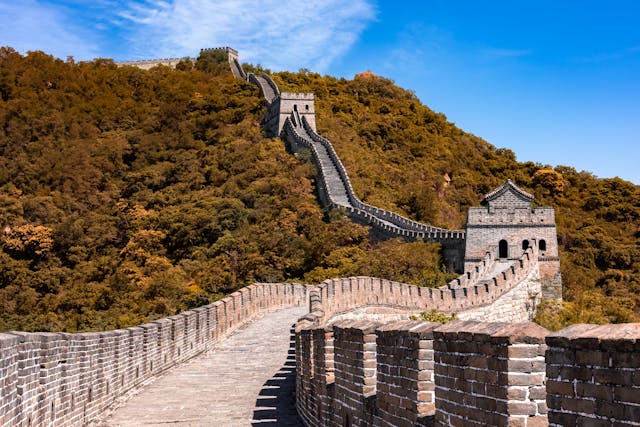
The Great Wall of China is the world's longest man-made structure, stretching approximately 21,196 km from Shanhaiguan in the east to Jiayuguan in the west. Construction began during the Spring and Autumn period (770–476 BC) when rival Chinese states built walls for protection. Emperor Qin Shi Huang (221–210 BC) unified China and ordered the connection of these walls, creating the first unified Great Wall. The most recognisable sections visible today were built during the Ming Dynasty (1368–1644) using fired grey bricks and lime mortar. Construction employed millions of soldiers, peasants, and convicted criminals – many perished on site, earning the Wall the grim nickname "the longest cemetery on earth." The Wall served not only as a military fortification but also regulated trade, controlled immigration, and collected tariffs on the Silk Road.
Architecture & Design
The Great Wall varies significantly along its length, reflecting local materials and the engineering knowledge of different eras. Ming Dynasty sections use fired grey bricks laid with lime mortar mixed with sticky rice paste for extra strength – tests confirm this mortar outperforms modern equivalents. The wall averages 7.8 m high and 5.8 m wide at the base, narrowing to 4.9 m at the top. Watchtowers were positioned every 200–300 m, rising above the walkway to serve as observation posts and garrison points. Beacon towers outside the Wall sent messages across hundreds of kilometres using smoke by day and fire by night. The wall's routing follows natural topography – mountain ridges and river bends – demonstrating sophisticated geographical planning across vastly different terrains.
Travel Tips & Visitor Information
Fun Facts & Did You Know?
- If all bricks in the Ming Wall were used to build a wall 5 ft high and 1 ft wide, it would circle the Earth twice
- About 30,000 watchtowers are spaced along the entire length of the wall
- The claim the wall can be seen from space is a myth – at only ~5 m wide it is far too narrow to see with the naked eye from orbit
- Sticky rice flour was mixed into the mortar during the Ming era; modern tests show it resists plant growth and is stronger than plain lime
- During the Ming Dynasty sections, some rammed-earth cores are still intact under the brick cladding
- The Great Wall is not a single continuous structure – there are gaps, parallel sections and ruins across multiple eras
How to Get There
Nearby Cities: Beijing (75 km), Tianjin (150 km), Chengde (180 km)
Official Website: http://www.badaling.cn ↗