⚡ Key Facts – Chichén Itzá
ℹ️ Fees subject to annual revision. Sound and light show is a separate ticket. (Fees verified 2024 – verify at official site before visiting.)
History of Chichén Itzá
Chichén Itzá was one of the largest and most important cities of the ancient Maya civilisation, founded around the 6th century AD in the Yucatán Peninsula. The city's name means "at the mouth of the well of the Itza people," referring to the Sacred Cenote – a natural sinkhole used for ritual offerings including jade, gold and human sacrifices. The city reached its greatest power during the Terminal Classic period (800–1000 AD) and shows evidence of both Maya and Toltec cultural influences. At its height the city probably housed over 50,000 people. Around 1250 AD the city was largely abandoned, though small populations remained. Spanish conquistadors reached the area in the 16th century. American archaeologist Edward H. Thompson purchased the hacienda at the site in 1894 and dredged the Sacred Cenote, recovering thousands of objects now in American museums – a source of ongoing repatriation disputes.
Architecture & Design
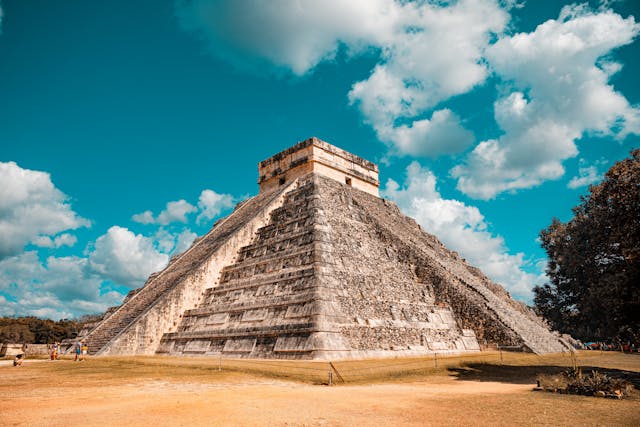
The centrepiece El Castillo (Temple of Kukulcán) is a nine-tier step pyramid 30 m high with precisely 365 steps across four stairways (91 per side plus the top platform), representing days of the solar year. During the spring and autumn equinoxes, the setting sun casts triangular shadows that create a feathered-serpent illusion appearing to descend the northern staircase – an effect that lasts about 34 minutes. The Great Ball Court is the largest in Mesoamerica at 168 × 70 m; its acoustics allow a whisper at one end to be heard clearly 140 m away. The Temple of Warriors features hundreds of carved warrior columns. El Caracol Observatory has windows aligned with Venus's extreme positions, proving advanced astronomical calculation. Since 2006, climbing El Castillo has been prohibited to prevent wear on the ancient stone.
Travel Tips & Visitor Information
Fun Facts & Did You Know?
- El Castillo was built over an earlier, smaller pyramid – archaeologists confirmed a second complete pyramid inside it using 3D scanning
- The Sacred Cenote yielded gold discs, jade jewellery, copal incense, pottery, and the remains of around 200 people – many children – offered as sacrifices
- The equinox shadow serpent "descends" in about 34 minutes as the sun moves
- The ball game played in the Great Ball Court may have used a 4-kg solid rubber ball; some interpretations suggest the losing team captain was sacrificed
- A buried third pyramid has been detected inside El Castillo using non-invasive scanning technology
- The site covers approximately 1,000 hectares though only the central ceremonial area is open to visitors
How to Get There
Nearby Cities: Cancun (190 km), Mérida (120 km), Valladolid (45 km), Pisté (2 km)
Official Website: https://www.inah.gob.mx ↗