⚡ Key Facts – Colosseum
ℹ️ Full experience (underground hypogeum + arena floor) must be pre-booked; limited slots. (Fees verified 2024 – verify at official site before visiting.)
History of Colosseum
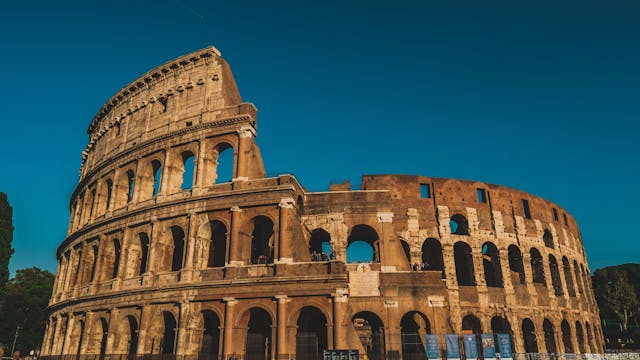
The Colosseum was commissioned by Emperor Vespasian of the Flavian dynasty around 72 AD on the site of an artificial lake from Emperor Nero's Domus Aurea. Construction was completed by his son Titus in 80 AD with further modifications under Domitian. An estimated 60,000–100,000 Jewish prisoners brought to Rome after the sack of Jerusalem in 70 AD provided slave labour. The inaugural games lasted 100 days and resulted in the deaths of 9,000 animals. At its peak the Colosseum seated 50,000–80,000 spectators, all admitted free as a tool of political popularity for emperors. Regular games ceased after the fall of the Western Roman Empire (476 AD); the last known gladiatorial contest took place in 435 AD and beast hunts continued until 523 AD. Medieval Romans used the structure as a quarry, removing vast quantities of travertine and bronze. The Colosseum has been a site of Catholic commemoration since the 8th century.
Architecture & Design
The Colosseum measures 188 m long, 156 m wide and 48 m high, covering 2.4 hectares. The elliptical design was chosen to prevent any spectator from being too far from the action. The exterior presents four tiers: the lowest three decorated with engaged half-columns in Doric, Ionic and Corinthian orders respectively; the fourth story features Corinthian pilasters and alternating windows. Eighty numbered arched gates (vomitoria) allowed 80,000 spectators to fill and empty the arena in minutes. Social class determined seating: senators at the ringside, then knights, upper classes, common citizens and finally women and the poor at the top tier. The hypogeum (underground level) contained 32 animal pens, gladiator cells, and 36 trap doors with counterweight elevators to raise animals and scenery into the arena. The velarium – a retractable canvas awning operated by 1,000 sailors – could shade the entire seating area.
Travel Tips & Visitor Information
Fun Facts & Did You Know?
- Construction consumed an estimated 100,000 cubic metres of travertine marble, fastened with 300 tonnes of iron clamps instead of mortar
- The English word "arena" derives from the Latin harena (sand) – the Colosseum floor was covered with sand to absorb the blood from combats
- Gladiators were not always condemned prisoners – many were professional athletes who chose the career for fame and financial reward
- The Vatican has held annual Good Friday Stations of the Cross processions at the Colosseum since 1749
- The underground hypogeum (completed by Domitian c. 82 AD) contained a miniature railway-like system of wooden lifts operated by teams of 8 men each
- Roman concrete (opus caementicium) used in the Colosseum is still studied today because it has proved more durable than modern concrete over 2,000 years
How to Get There
Nearby Cities: Rome (site is in the historic centre)
Official Website: https://www.il-colosseo.it ↗