⚡ Key Facts – Petra
ℹ️ Jordan Pass (~JOD 70–80) includes Petra + Jordan visa – excellent value for multi-day visits. (Fees verified 2024 – verify at official site before visiting.)
History of Petra
Petra was the capital city of the Nabataean Kingdom, established around 312 BC by an Arab nomadic people who became extraordinarily wealthy by controlling caravan trade routes between Arabia, Egypt, and the Mediterranean. Their mastery of water engineering – including cisterns, dams, channels, and ceramic pipes – allowed a city of 20,000–30,000 people to thrive in an arid desert canyon. Petra reached its peak prosperity between the 1st century BC and 1st century AD. It was conquered by Rome in 106 AD and became the capital of the province of Arabia Petraea. A catastrophic earthquake in 363 AD destroyed much of the city's water system, triggering a long decline. Swiss explorer Johann Ludwig Burckhardt, disguised as a Muslim pilgrim, became the first Western explorer to visit the site in 1812 and reintroduced it to the world. Excavations have been ongoing since the early 20th century.
Architecture & Design
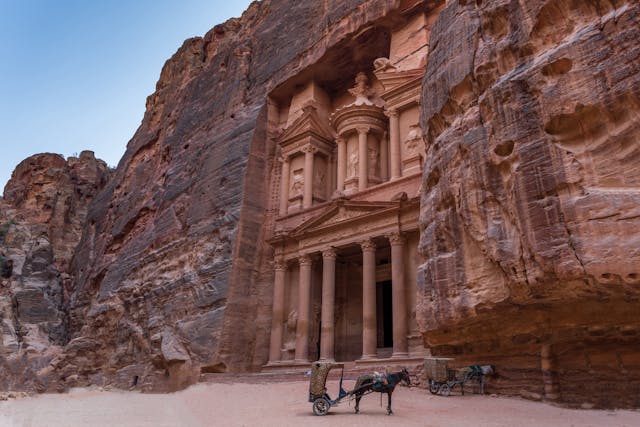
Petra's most iconic monument is Al-Khazneh (The Treasury), a 43-m-high Hellenistic façade carved entirely from a single sandstone cliff in the 1st century BC – almost certainly the mausoleum of Nabataean King Aretas IV. The entrance corridor known as the Siq is a 1.2-km natural gorge with walls rising 80–200 m, creating a dramatic approach. The city contains approximately 800 carved monuments including temples, tombs, houses and public buildings. The Monastery (Ad Deir) surpasses the Treasury in scale at 50 m wide, reached by a 45-minute hike up 800 rock-cut steps. An 8,500-seat Roman amphitheatre was carved directly into the hillside. The Nabataean water system extended 200 km and included dams to divert flash floods, 500 cisterns carved into rock, and a ceramic pipe network maintaining constant water pressure.
Travel Tips & Visitor Information
Fun Facts & Did You Know?
- Only about 15% of Petra has been excavated – an estimated 85% of the ancient city remains buried
- The Treasury's name comes from a Bedouin legend that an Egyptian pharaoh hid treasure inside the stone urn at the top – Bedouin tribesmen shot at the urn for centuries, which explains the bullet marks still visible
- Sandstone façades were carved from the top down – workers started at the cliff summit and carved downward
- The Nabataean alphabet that developed at Petra is a direct ancestor of modern Arabic script
- Petra's 200-km water system could store 12 million litres of water – enough to supply the city for months
- Flash floods can fill the Siq within minutes; the Nabataeans built a tunnel and dam to divert these floods away from the city
How to Get There
Nearby Cities: Wadi Musa (2 km), Aqaba (130 km), Amman (230 km)
Official Website: https://www.visitpetra.jo ↗